Drive to the top of Oʻahu and, just past the town of Kahuku, there’s a farm stand that turned into one of the North Shore’s best lunch stops. Kahuku Farms, at 56-800 Kamehameha Highway, serves paninis, smoothies and açaí bowls made with fruit grown in the fields behind the café, and it will put you on a tractor-pulled wagon to see where it all comes from.
The café is the newest chapter of a much longer story.
Two plantation families
Kahuku Farms is the result of two farming families with more than 100 years and four generations in Hawaiʻi, according to the farm’s own history. Descendants of the Matsuda and Fukuyama families came from Japan in the early 1900s to work on the sugar plantations. “They came right here to the top of Oahu to work in the Kahuku sugarcane plantation,” director of operations Judah Lum told Hawaii News Now in 2025.
When the Kahuku plantation shut down in the early 1970s, the families pivoted to farming on their own. Lum told Hawaii News Now that his wife’s grandfather had been the plantation’s irrigation supervisor when it closed, so he knew the water system well, and that he went on to create the Kahuku Farms Association.
Shinichi and Torie Matsuda started growing bell peppers, papayas, watermelon and bananas in the 1940s and were later joined by their son Melvin, according to the farm’s Oʻahu Fresh profile and a 2010 report in The Honolulu Advertiser. Nearby, Masatsugu and Nora Fukuyama grew watermelon, eggplant, papaya and cucumbers, and their son Clyde joined them in the 1960s.
A handshake merger
Clyde Fukuyama and Melvin Matsuda grew up on neighboring farms and became childhood friends, the farm says. With similar goals, they combined the family farms “with a hand shake” in the 1980s. Oʻahu Fresh dates the merger to 1986, creating the Kahuku Brand label. The Advertiser reported in 2010 that the two farms started working together in 1986 and formally merged into Matsuda/Fukuyama Farms in 1995.
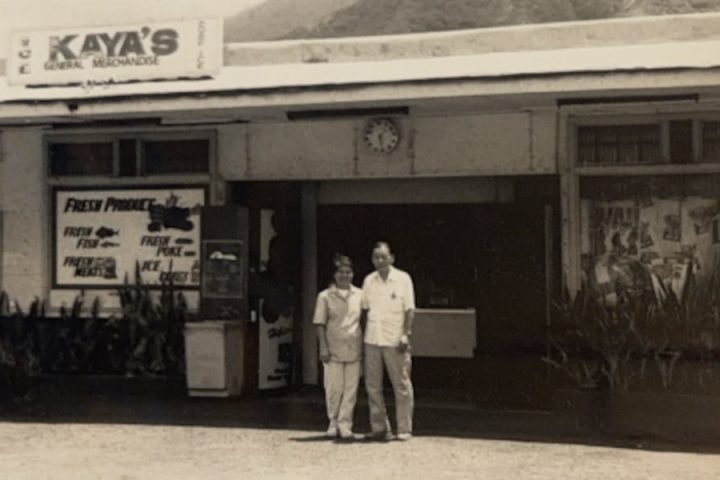
For years, the farm was best known for its watermelon. “A lot of people made it a tradition to come out here and buy the watermelon straight from the farm,” Lum told Hawaii News Now. The farm’s photo archive includes the old Fukuyama family watermelon stand in the early 1980s and a 1996 roadside stand with Shinichi and Torie Matsuda and Masatsugu Fukuyama.
As soil and market conditions changed, the commercial side shifted to crops that grow year-round. Today the parent company, Matsuda-Fukuyama Farms, specializes in papaya, apple banana, long eggplant and lūʻau leaf sold under the Kahuku Brand label in supermarkets around the island, according to the farm and Hawaii News Now.
How big is the farm? It depends on when you ask. The Advertiser described about 300 acres of leased land in Kahuku and Haleʻiwa in 2010, the Star-Advertiser reported 125 acres in 2015, and the farm and Hawaii News Now now describe a 140-acre operation.
The fourth generation brings the tables to the farm
Kylie Matsuda, Melvin’s daughter, didn’t plan on farming. She earned a degree in travel industry management and worked in nursery plant sales and at Nalo Farms before joining the family business, the Advertiser reported in 2010. “They thought I was absolutely crazy,” she told the paper. “I really had to fight for my job.”
Her idea was agritourism: a country store, farm tours and food made from the farm’s own produce. It took about five years of planning and permitting, according to the Star-Advertiser. In October 2010, Kylie Matsuda-Lum and her husband, Judah Lum, sectioned off the front five acres of the family farm and opened Kahuku Farms to the public. The café opened with just Kylie, her sister Kalyn Matsuda and Judah working in the kitchen, the paper reported.
The café was also a way to waste less. Grocery stores want “pretty” produce, so blemished apple bananas go into smoothies and banana bread, and curly long eggplants end up in the grilled veggie panini, the farm explains on its café page. Education was the other goal. “There are so many children out there who think a banana comes from Costco,” Kylie told the Advertiser.
The açaí experiment
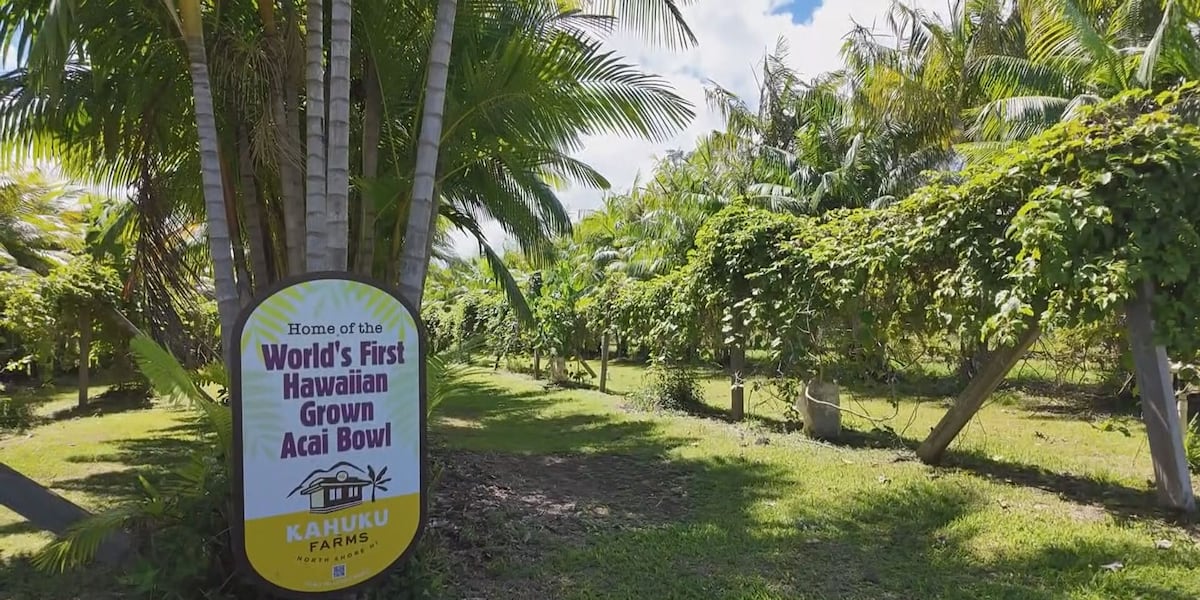
Kahuku Farms’ best-known menu item took the longest to grow. The farm started growing açaí palms around 2009. It took about eight years for them to bear fruit, then months more for the Lums to work out how to process the berries, according to HONOLULU Magazine. After more than 20 versions, they rolled out the bowl in February 2017, which the magazine called likely the first locally grown açaí bowl in Hawaiʻi. A sign at the farm now calls it the “World’s First Hawaiian Grown Acai Bowl.”
The current version blends farm-grown açaí with apple bananas, mixed berries and house-made haupia sauce, topped with the farm’s liliko’i butter, apple banana slices, a mac-nut crumble and granola, per the café menu. The menu notes it is seasonal.
What to do there now
- Eat: The café serves smoothies made with hand-picked farm fruit, paninis, farm pizza, loaded garlic bread, grilled banana bread and liliko’i butter butter mochi. The menu says ingredients come from the farm or neighboring local farms.
- Wander: The café gardens are free to explore during business hours, with açaí palms, cacao, liliko’i and other seasonal crops, according to the farm’s visitor page.
- Ride: The Grand Tour is a 1.5- to 2-hour tractor-pulled wagon ride through the fields that typically starts at 11:15 a.m. Thursday through Monday, with tastings of seasonal fruit and chocolate made from the farm’s cacao, per the tour page. Reservations are recommended.
- Walk: The newer Aloha ʻĀina Legends Walking Tour is about an hour, starting at 2 p.m. Thursday through Monday, with legends of Kahuku, canoe plants, music and tastings.
- Stay late: Fireside at the Farm is a private, hosted bonfire evening with a farm take on s’mores. The farm’s homepage also advertises a limited-time kamaʻāina special for Hawaiʻi ID holders; check the booking page for details.
Why it matters
Plenty of North Shore stops sell shrimp plates and shave ice. Kahuku Farms is a working farm whose families have been on this land since the plantation days, and it found a way to keep farming by inviting the public in. “We’re standing on the shoulders of giants,” Lum told Hawaii News Now.
Know before you go
- Where: 56-800 Kamehameha Hwy., Kahuku
- Hours: Thursday to Monday, 11 a.m. to 4 p.m.; closed Tuesdays and Wednesdays. Closed Thanksgiving (Nov. 26), Christmas and New Year’s Day, per the farm’s website
- Cost: Garden entry is free; tours require tickets (book at kahukufarms.com)
- Phone: (808) 628-0639
- Bring: Comfortable shoes, sunscreen and water for tours; the farm is fully outdoors and tours run rain or shine unless the weather is severe
Sources
- Kahuku Farms, “About” (family history, 140 acres, crops): https://kahukufarms.com/pages/about
- Kahuku Farms, café, menu, visitor and tour pages (hours, tours, holiday closures; checked Nov. 10, 2026): https://kahukufarms.com/pages/the-cafe, https://kahukufarms.com/pages/cafe-menu, https://kahukufarms.com/pages/the-farm, https://kahukufarms.com/pages/the-grand-tour, https://kahukufarms.com/pages/aloha-aina-legends-walking-tour, https://kahukufarms.com/
- Hawaii News Now, “From roadside stands to acai bowls, Kahuku Farms thrives over generations” (Oct. 17, 2025): https://www.hawaiinewsnow.com/2025/10/17/roadside-stands-acai-bowls-kahuku-farms-thrives-over-generations/
- Honolulu Star-Advertiser, “Discover wagon tours, farm fresh food at Kahuku Farms” (Aug. 24, 2015): https://www.staradvertiser.com/2015/08/24/travel/hawaii-highlights/discover-wagon-tours-farm-fresh-food-at-kahuku-farms-3/
- The Honolulu Advertiser, “Kahuku Farms tries new ventures” by Robbie Dingeman (May 26, 2010): https://the.honoluluadvertiser.com/article/2010/May/26/bz/hawaii5260325.html
- HONOLULU Magazine, “Farm Friday: Locally Grown Acai at Kahuku Farms” (Apr. 28, 2017): https://www.honolulumagazine.com/farm-friday-locally-grown-acai-at-kahuku-farms/
- Oʻahu Fresh, Kahuku Farms farmer profile: https://www.oahufresh.com/farmers/kahuku-farms/
Filed under North Shore
The Oahu Local newsletter
Enjoyed this? Get Oahu Local every week.
Our free weekly email helps you plan the weekend: events, food, hidden gems and the local news that matters, written by people who live here.