Ask anyone where to get a malasada on Oʻahu and you’ll probably hear one name first.
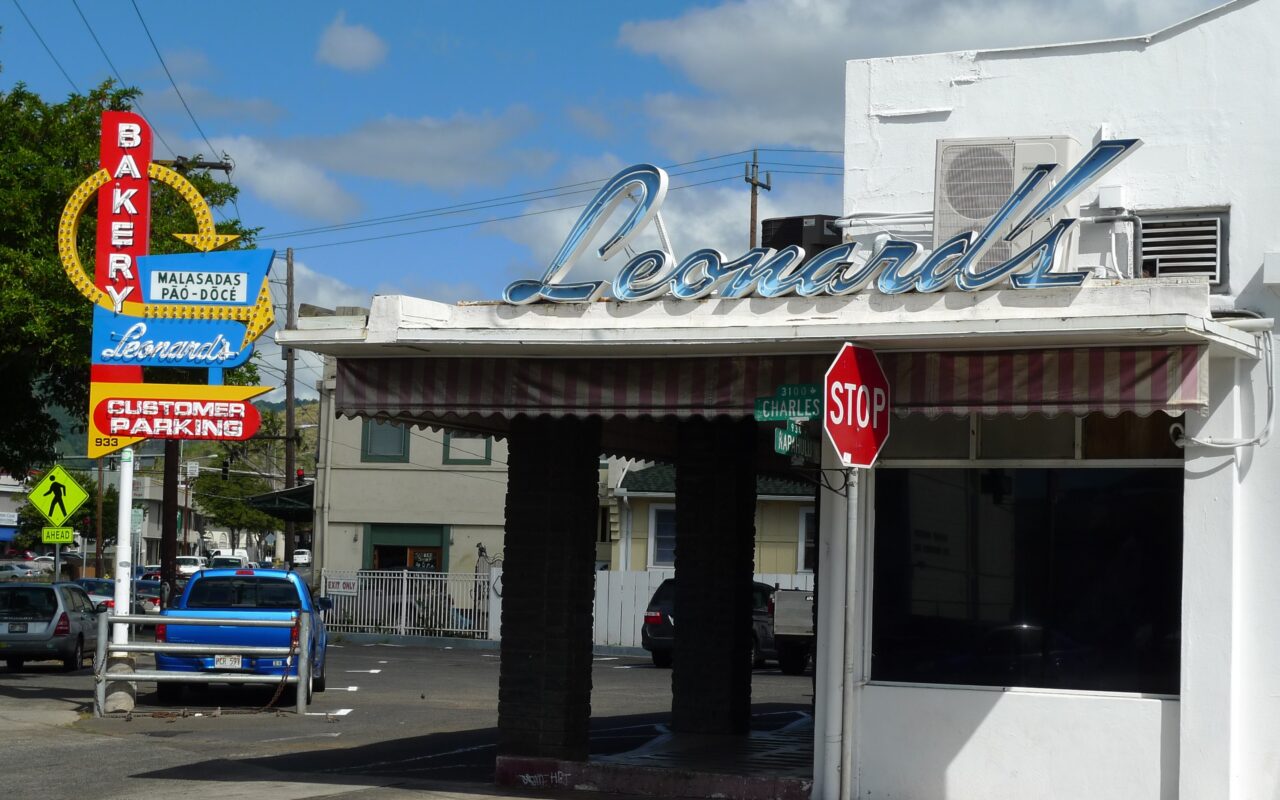
Leonard’s Bakery on Kapahulu Avenue has been frying them for more than 70 years, and the line out the door is part of the experience. Here’s how a sugar plantation family from Maui ended up teaching Hawaiʻi, and later Japan, to love a Portuguese doughnut without a hole, based on the bakery’s own history and decades of local reporting.
From São Miguel to Maui
The story starts with a ship. In June 1882, the British sailing ship Monarch brought Arsenio and Amelia DoRego from São Miguel in Portugal’s Azores to Maui, where they had contracts to work the sugar cane fields, according to Leonard’s Bakery. Their grandson Leonard was born 33 years later.
That was Frank Leonard Rego Sr., born in 1915, as HONOLULU Magazine noted when it named him to its list of 100 people who shaped the city. In 1946, Leonard and his wife, Margaret, moved to Honolulu with their 8-year-old daughter, Diane. Leonard worked at Snowflake Bakery until he opened his own bakery in 1952, the company says.
“Leonard never went to college, but was a real go-getter,” his niece Charlotte Cox told HONOLULU Magazine. She remembered him delivering a huge pink box of malasadas almost every day to her father’s company.
The idea that changed everything
The malasada wasn’t part of the original plan. Not long after the bakery opened, Leonard’s mother suggested making malasadas for Shrove Tuesday, the Portuguese tradition of frying sweets before Lent, the bakery says. Despite worries that malasadas might seem “too ethnic,” Leonard’s bakers made them, and they were a huge hit. The Honolulu Star-Advertiser identified her as Mary in 2012.
Accounts differ on the year. The bakery’s malasada page says it started making them for Shrove Tuesday in 1953. A 2014 Star-Advertiser item put the start in 1962. Either way, what began as a once-a-year treat became an everyday one. “Now, we make them continuously everyday,” the bakery’s site says, and it calls itself “Hawaii’s original malasada” bakery.
The name has a humble meaning. The Star-Advertiser wrote in 2012 that “malasada” means “badly cooked” in Portuguese, and a guest on PBS’s “ʻONO! Hawaiʻi’s Food Culture” translated it as “bad bread,” meaning dough that didn’t rise properly for bread. Island radio and TV personality Lucky Luck helped spread the word in Leonard’s TV commercials, the Star-Advertiser noted.
The move to Kapahulu
As the malasadas caught on, the bakery outgrew its first spot down the street and moved in 1957, the founders’ grandson says in the PBS episode. It has been at 933 Kapahulu Ave. ever since.
Frank Leonard Rego Sr. died in 1980, according to HONOLULU Magazine. The business passed to the next generation, and his son, known as Leonard Rego Jr. or Lenny Jr., was running it as president by the 2000s.
Taking malasadas to Japan
In 2008, the bakery made its first move off Oʻahu. A group of Japanese investors, Forest Inc., approached Rego Jr. that March about licensing the Leonard’s name, and a store opened that December in the Yokohama World Quarter Shopping Center, The Honolulu Advertiser reported in 2009. Rego flew to Japan and spent a week and a half teaching the staff how to make malasadas.
By mid-2009, the Yokohama shop was selling 4,000 to 5,000 malasadas a day at 150 yen each, the Advertiser said. At the time, the company had about 60 employees, sold about 12,000 malasadas a day across all its stores, and charged 70 cents for a malasada in Hawaiʻi. A Leonard’s Japan website is still active.
By the numbers
- 1952: Leonard’s opens. In 2012, the Star-Advertiser reported the bakery was selling more than 15,000 malasadas a day and had sold more than 160 million since opening
- 2012: The Honolulu City Council honored the bakery for its 60th anniversary, according to the bakery’s press page
- 2014: Sugar, cinnamon-sugar and li hing malasadas cost $1, and filled malasada puffs cost $1.35, the Star-Advertiser reported
- 2027: Leonard’s will celebrate its 75th anniversary, the Star-Advertiser reported in February
Three generations on Kapahulu
The family is still in charge. Frank Leonard Rego Jr. remains the owner, and his son Frank Leonard Rego III, who goes by Lenny, works in the business with his sister Tiana and brother Pavel, the Star-Advertiser reported in February 2026. Lenny, who studied electrical engineering, joked to the paper that the bakery just wouldn’t be the same if it had been called “Frank’s.”
“I’m honored to be a part of a family legacy and a local tradition, and helping to keep the tradition of the malasada alive,” he told the Star-Advertiser.
What makes a Leonard’s malasada different
In the PBS episode, the grandson walks through the process. The dough is mixed, portioned onto trays and proofed, then a fryer hand-cuts each piece and fries it for about five minutes, until it’s golden brown. Leonard’s added cinnamon-sugar and li hing sugar coatings over the years, and it popularized the malasada puff, a malasada with filling inside, he says.
What to order
- The classic: an original sugar-coated malasada, hot. The bakery describes them as golden brown outside and “light & fluffy” inside
- Coated: cinnamon-sugar or li hing sugar
- Malasada puffs: In 2014 the fillings were dobash (chocolate), custard, haupia and a flavor of the month, the Star-Advertiser reported. Check the board for this month’s flavor
- Beyond malasadas: pao doce (Portuguese sweet bread), Portuguese sausage wraps and butter mochi, per the Star-Advertiser
Prices have gone up since 2014, so check the menu board.
Know before you go
- Where: 933 Kapahulu Ave., Honolulu
- Hours: daily, 5:30 a.m. to 7 p.m., per the bakery’s website and its Google listing
- Skip the line: Kapahulu takes phone orders of at least a dozen malasadas at (808) 737-5591. Call at least an hour before pickup, then go straight to the cashier, the bakery says
- Malasadamobiles: the bakery’s trucks sell hot malasadas at Waikele Shopping Center, Pearlridge Center, Windward Mall and Koko Marina Center. They don’t take phone orders, and the Waikele and Pearlridge trucks are cashless, according to the Malasadamobile page. Check that page for hours before you go
- Delivery: Leonard’s says it isn’t affiliated with any food delivery service
Craving more bakery history? Read our profiles of Liliha Bakery and Ted’s Bakery.
Related on Oahu Local: Matsumoto Shave Ice History: 75 Years in Haleiwa · Honolulu Restaurants · More Honolulu stories
Sources
- Leonard’s Bakery, About, Malasadas, Malasadamobile, Locations and Press pages, checked Nov. 18, 2026: https://www.leonardshawaii.com/about/ ; https://www.leonardshawaii.com/malasadas/ ; https://www.leonardshawaii.com/malasadamobile/ ; https://www.leonardshawaii.com/press/
- HONOLULU Magazine, “The HONOLULU 100 – Frank Leonard Rego Sr. to Matsuo”: https://www.honolulumagazine.com/the-honolulu-100-frank-leonard-rego-sr-to-matsuo/
- Honolulu Star-Advertiser, “Some food for thought about Hawaii’s bakeries” (Dec. 21, 2012): https://www.staradvertiser.com/2012/12/21/business/some-food-for-thought-about-hawaiis-bakeries/
- Honolulu Star-Advertiser, “5 Things We Love” (May 26, 2014): https://www.staradvertiser.com/2014/05/26/features/5-things-we-love-161/
- Honolulu Star-Advertiser, “Kapahulu: Longtime community gems” (Feb. 4, 2026): https://www.staradvertiser.com/2026/02/04/food/island-eats/kapahulu-longtime-community-gems/
- The Honolulu Advertiser, “Bakery sweet on franchising,” Taylor Hall (June 15, 2009): https://www.honoluluadvertiser.com/article/2009/Jun/15/bz/hawaii906150308.html
- PBS / PBS Hawaiʻi, “ʻONO! Hawaiʻi’s Food Culture: How the Portuguese Malasada Took Over Hawaiʻi” (Sept. 26, 2025): https://www.pbs.org/video/how-the-portuguese-malasada-took-over-hawaii-c5dlns/
- Leonard’s Japan, official website: https://leonardsjapan.com/
- Google Places listing (hours), checked Nov. 18, 2026
Filed under Honolulubakeriesfamily businessKapahuluLeonard's Bakerylocal business profileMalasada DaymalasadasPortuguese
The Oahu Local newsletter
Enjoyed this? Get Oahu Local every week.
Our free weekly email helps you plan the weekend: events, food, hidden gems and the local news that matters, written by people who live here.