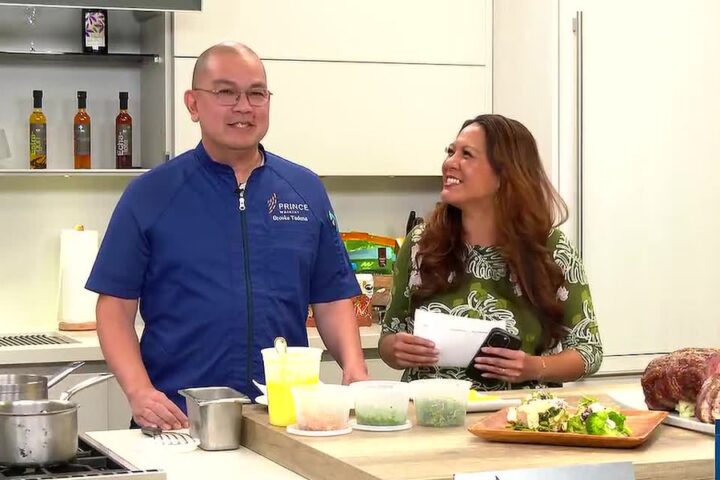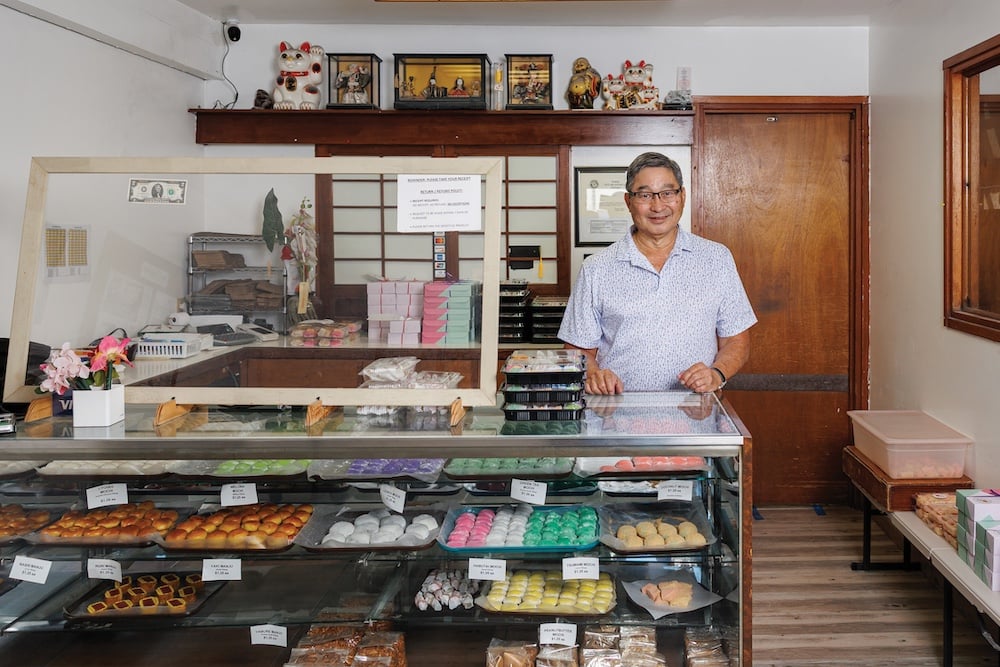
You can drive past Nisshodo Candy Store a hundred times and never see it. The shop sits in a jumble of industrial warehouses on Dillingham Boulevard, with a faded sign and a tiny retail lobby, as the Honolulu Star-Advertiser described it on the shop’s 100th anniversary. Customers find it anyway. When a Hawaii News Now crew visited in January, it reported nonstop foot traffic.
What they come for is the same thing Honolulu has been buying from the Hirao family for 105 years: chichi dango, mochi and manju made from scratch, mostly by hand.
From the plantations to a candy store by ʻAʻala Park
Asataro Hirao came to Hawaiʻi from Hiroshima, Japan, to work on the sugar plantations. In 1921 he switched to making the rice sweets of his homeland, his grandson Michael “Mike” Hirao told the Star-Advertiser.
He didn’t start alone. Hawaii News Now reports that Asataro founded the store with three friends, and Hawaii Business Magazine says he opened it on King Street with fellow immigrants, including Jokichi Tasaka, who went on to found Tasaka Guri Guri on Maui. The partners eventually went their separate ways, and Asataro kept the Honolulu business going.
The store was originally housed in an old two-story building next to ʻAʻala Park. After that building was heavily damaged by fire, the business moved to its current Dillingham Boulevard location in 1984, according to the Star-Advertiser.
The chichi dango recipe from Shobara
Here’s a detail that surprises people: the founder of one of Honolulu’s oldest mochi makers didn’t arrive knowing how to make mochi. “Actually, he really didn’t know how to make mochi when he first came here,” Michael Hirao told Hawaii News Now.
The shop’s signature, chichi dango, traces to Asataro’s hometown of Shobara, a farming area of Hiroshima. Michael Hirao told HNN that a dairy there had extra milk, so someone tried using milk in place of water in a traditional recipe. Asataro went back to Japan to learn it firsthand, and the dairy hired him temporarily so he could master it. As Hirao put it, they didn’t see a Hawaiʻi shop as direct competition.
Chichi dango, the soft, lightly sweet dumpling in white or pink and wrapped in a twist of paper, has long been Nisshodo’s bestseller. In 2021 the Star-Advertiser reported it was still made in a Japanese cooker-mixer built in the 1950s and poured into aged wooden trays to cool before cutting.
Three generations of Hiraos
Asataro passed the recipes and the mochi-making skills to his sons. Richard Hirao and his brother Thomas, along with their sisters, made up the second generation to run the store, the Star-Advertiser reported.
Michael, Richard’s son, grew up in it. He started at the shop at 5 or 6, folding boxes and serving as the store’s doorbell. With no bell system and everyone working in the back, he would yell, “There’s a customer!” He told the Star-Advertiser his grandfather was intense, “very strong-willed. But very fair.”
Michael had a career in banking first. Hawaii News Now says he took over the family business in 2008; the Star-Advertiser reported in 2021 that he retired from banking in 2009 and had helped his father run the shop even while he was still working. Today he runs Nisshodo with his wife, Ursula, according to Hawaii Business, which inducted the shop into its 2025 SmallBiz Editor’s Choice Award Hall of Fame. He credits her and the family for the shop’s survival. “She helped it survive, yes,” he told HNN.
Still made the old way
Production happens in the back and a small retail counter takes care of customers up front, Hirao told Hawaii Business. A team of 12 makes the sweets, runs the store and wholesales to other companies, and HNN reports the crew starts at 5 a.m. so the case is stocked with fresh sweets.
Some things have modernized. “We don’t use charcoal anymore, we use gas now,” Hirao told the Star-Advertiser, and a machine now strains the beans for the fillings, which are still made from scratch, 50 pounds of beans at a time. But there is no machine for shaping mochi, so the cutting, shaping and finishing are done by hand.
The store has outlasted the Great Depression, World War II, a fire and the COVID-19 pandemic, which closed it for about a month in 2020, according to the Star-Advertiser. Its latest hurdle, per HNN, is rail construction in the area.
What to get
The glass case holds kinako dango, manju and kingyoku alongside the chichi dango, and the shop’s website also lists rakugan. Mochi and manju fillings range from traditional azuki bean to flavors added over the years at customers’ request:
- Chichi dango, the bestseller, in white or pink
- Peanut butter mochi, Michael Hirao’s personal favorite, he told both the Star-Advertiser and Hawaii Business
- Coconut and lilikoʻi, popular tropical flavors the Star-Advertiser noted, plus melona, per Hawaii Business
- Daifuku, ugu isu and chimaki, among the varieties on the shop’s website
You can buy individually or by the pound, and the shop takes orders by phone, according to its website.
Plan ahead for New Year’s
New Year’s is one of Nisshodo’s busiest seasons, along with Girls’ Day (March 3) and Boys’ Day (May 5), the Star-Advertiser reported. Mochi is a New Year’s staple in Hawaiʻi for good luck in the year ahead, and Aloha State Daily included Nisshodo in its guide to where to get mochi for New Year’s last year. If you want a box for your ʻohana’s New Year’s table, call early to ask about ordering.
Know before you go
- Where: 1095 Dillingham Blvd., Honolulu, in a warehouse complex; give yourself a minute to find it
- Phone: (808) 847-1244; the shop asks customers to call to place orders
- Hours: Nisshodo doesn’t list hours in a form we could confirm, so call before you go. It was closed Sundays when the Star-Advertiser visited in 2021.
- Good for: omiyage, New Year’s, Girls’ Day and Boys’ Day, or a box for the office
Love a long-running family food business? Read our histories of Fukuya Deli in Mōʻiliʻili and Liliha Bakery.
Related on Oahu Local: Honolulu Restaurants · More Honolulu stories · Helena’s Hawaiian Food at 80: History, Pipikaula, Menu D
Sources
- Honolulu Star-Advertiser, “Nisshodo Candy Store in Kalihi has been turning out mochi and other Japanese confections for 100 years,” Pat Gee (July 18, 2021): https://www.staradvertiser.com/2021/07/18/features/nisshodo-candy-store-in-kalihi-has-been-turning-out-mochi-and-other-japanese-confections-for-100-years/
- Hawaii News Now, “Inside Nisshodo Candy Store’s sweet, century-old history,” Jolanie Martinez (Jan. 22, 2026): https://www.hawaiinewsnow.com/2026/01/22/inside-nisshodo-candy-stores-sweet-century-old-history/
- Hawaii Business Magazine, “Nisshodo Candy Store Blends Local Favorites with New Flavors,” Laurel Galvin (May 12, 2025): https://www.hawaiibusiness.com/nisshodo-candy-store-blends-local-favorites-with-new-flavors/
- Aloha State Daily, “Where to get mochi for New Year’s,” Kelli Shiroma Braiotta (Dec. 27, 2025): https://alohastatedaily.com/2025/12/26/where-to-get-mochi-for-new-years/
- Nisshodo Candy Store website (about, mochi and manju pages): https://www.nisshodomochicandy.com/
Filed under Honoluluchichi dangoIwileiJapanese sweetsKalihilocal business profilemochiNew Year's mochiNisshodo Candy Store
The Oahu Local newsletter
Enjoyed this? Get Oahu Local every week.
Our free weekly email helps you plan the weekend: events, food, hidden gems and the local news that matters, written by people who live here.