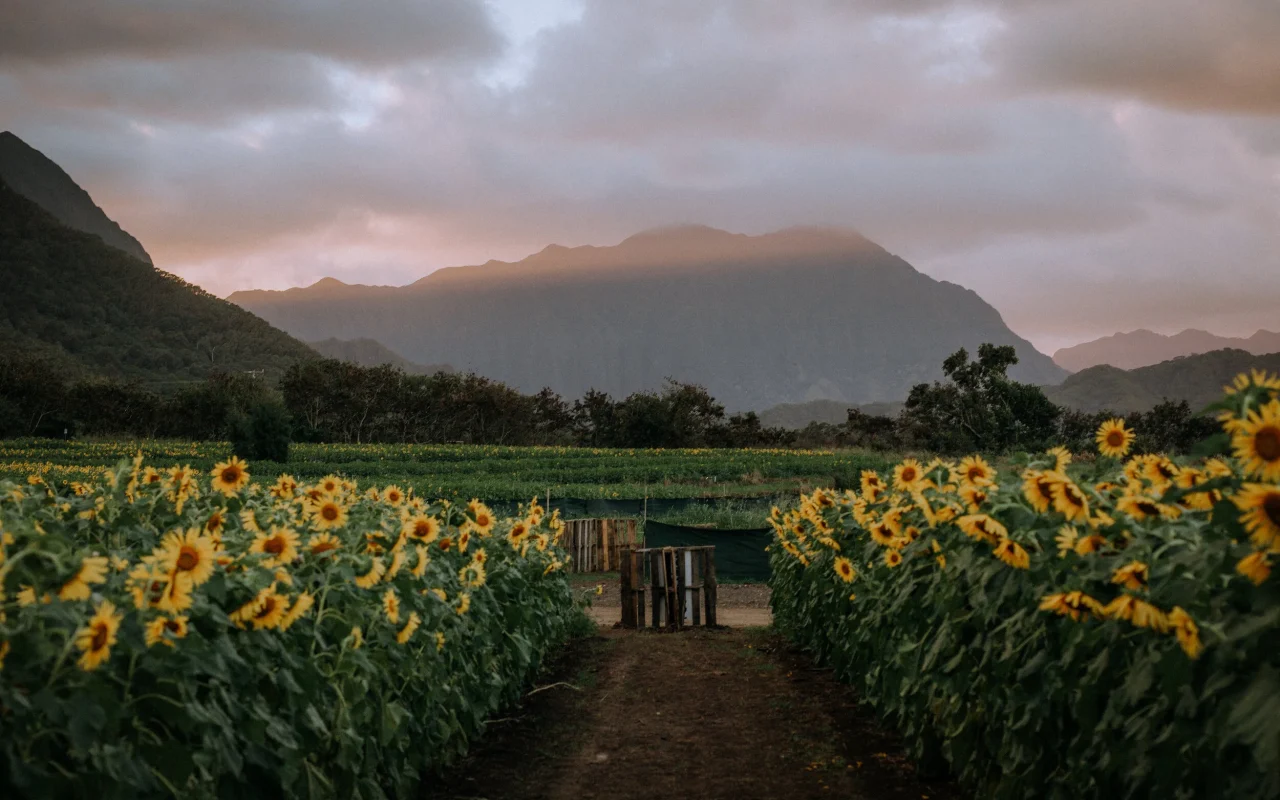
Every fall, Oʻahu families head to Waimānalo for pumpkins, photos in the sunflower fields and a cold cup of lemonade. Waimānalo Country Farms has become such a fixture of fall on Oʻahu that it’s easy to forget it’s a working farm first. According to the farm’s own history, it covers 52 acres and spans six generations of one family.
Truck farming, then melons
Accounts differ on who founded the farm. Its website says it started in 1948 as Golden Melon Farm, founded by Gee Chong Wong, Tuckee Wong and Ronald K.S. Wong, the current family’s great-great-grandfather and great-grand-uncles. A 2015 profile in Ka ʻOhana, Windward Community College’s student paper, instead credits Ronald Kadooka with founding it in 1948. At first it covered only the plot now called field four. As neighboring farmers gave up their land, the family took it on, one parcel at a time.
Through the 1950s, it was a “truck farm” growing broccoli, kai choi, green onion, Chinese peas, sweet potato and tomatoes. From about 1960 to 1972 it was all about melons, with 13 varieties by the family’s count. The farm says it was the first to grow the “golden melon,” which is yellow outside and deep red inside, and it kept the Golden Melon name until 2001.
The corn years
Then came the Vietnam War. The farm’s history says the young men of the family went off to serve. With fewer hands, the family switched to corn, which took less labor, and the farm stuck with corn for nearly four decades.
Shawn Kadooka, who grew up working on the farm, and her husband Dominic learned the business from Uncle Ronald between 1991 and 2001. In 2001, as the farm puts it, he handed them the tractor keys. The farm’s website describes them as the current owners. The dates for the switch to corn vary a little: the farm’s timeline has melons until about 1972, while Dominic Kadooka told BYU–Hawaiʻi’s student paper, Ke Alakaʻi, in 2023 that the family had grown corn since 1970.
Opening the gate
The big change came around 2009 or 2010; accounts differ on the year. The farm’s site says the pumpkin patch and the first sunflowers both started in 2010, along with NaloMade lemonade, which the farm sells at its events and at farmers markets, while Ka ʻOhana dated the first patch to 2009. In that 2015 profile, Shawn Kadooka, a WCC alumna, described opening the first patch after several hard years of farming. She told the paper the family simply put up a sign on the road and the public showed up. She also said the patch was drawing about 20,000 visitors a year at that time.
The sunflowers have their own origin story. Dominic Kadooka told Ke Alakaʻi the fields started when a family member wanted to get married in one. He also described pressing the seeds into oil for cooking and for tractor fuel. The farm keeps bees too, and it sells its own honey.
Today the farm is open to the public only during special events, according to its FAQ, and the fall harvest festival is the biggest of them. Hawaii News Now reported that this year’s festival opened late, after storm flooding, and that it runs through Nov. 11. The farm’s site lists cash admission of $10 for kamaʻāina and military and $12 general, Monday through Thursday, and $12 and $15 Friday through Sunday. Card payments add a 3.5% fee plus tax. Pumpkins and sunflowers are priced separately, and its after-dark Rustic Nights event has sold out, per HNN.
Planning a visit
A few tips from the farm’s FAQ:
- Wear closed-toe shoes. It’s a real working farm, with bugs, dirt and uneven ground.
- Leave pets at home. Only ADA service dogs are allowed.
- Don’t bring outside food or drinks. Water is the exception.
- Carpool. Parking is limited, and the gate may close when the lots are full.
- Arrive by 4 p.m. That’s the last entry.
Also note that the farm is a private, working farm the rest of the year. If you can’t make the festival, you can find NaloMade lemonade at the Kailua farmers market on Thursday evenings and the KCC farmers market, except during farm events. The farm posts updates on Instagram at @waimanalocountryfarms.
Why it matters
Waimānalo has long been one of Oʻahu’s farming centers. Every family that keeps a farm going there keeps a little of that alive. Waimānalo Country Farms has done it by changing crops when it had to and by inviting the public onto the land, so a corn farm became a place thousands of Oʻahu families visit every fall.
This profile draws on the farm’s published history and on earlier published interviews with the family.
Sources
- Waimānalo Country Farms, About (farm history): https://www.waimanalocountryfarms.com/about-us
- Waimānalo Country Farms, Fall Harvest 2026 (prices and hours): https://www.waimanalocountryfarms.com/
- Waimānalo Country Farms, FAQ: https://www.waimanalocountryfarms.com/faq
- Hawaii News Now, “Waimanalo Country Farms fall harvest festival opens on Oahu after storm delay” (Oct. 2, 2026): https://www.hawaiinewsnow.com/2026/10/03/waimanalo-country-farms-fall-harvest-festival-opens-oahu-after-storm-delay/
- Ka ʻOhana (Windward Community College), “Alumna opens annual pumpkin patch,” Oct. 19, 2015: https://kaohana.windward.hawaii.edu/2015/10/alumna-opens-annual-pumpkin-patch/
- Ke Alakaʻi (BYU–Hawaiʻi), “A blossoming legacy at Waimanalo Country Farms,” Mutia Parasduhita, Aug. 23, 2023: https://kealakai.byuh.edu/a-blossoming-legacy-at-waimanalo-country-farms
Filed under Windward Oahufamily farmHidden Gemslocal business profilepumpkin patchsunflowersWaimanaloWaimanalo Country FarmsWindward Oahu
The Oahu Local newsletter
Enjoyed this? Get Oahu Local every week.
Our free weekly email helps you plan the weekend: events, food, hidden gems and the local news that matters, written by people who live here.